

Problem Statement
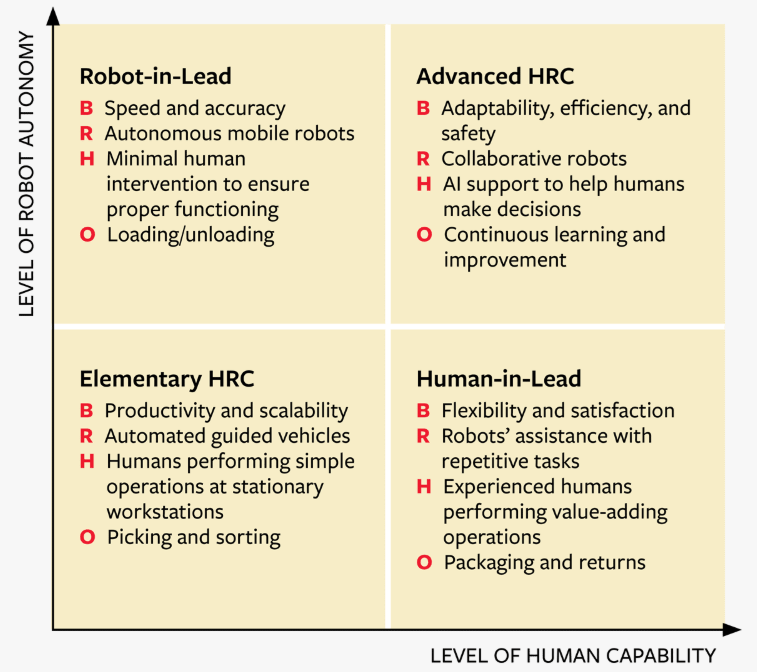
Despite the significant and growing capital investment in robotics for logistics—with 80% of warehouses expected to deploy some form of automation by 2028—Human-Robot Collaboration (HRC) remains sub-optimized and is currently failing to realize its full potential. The core problem is the lack of a systematic and data-driven approach to define and manage the dynamic roles of humans and robots, often leading to a mismatch between human capability and robot autonomy. Therefore, there is a critical need for a structured framework, empowered by AI technologies, to advance HRC beyond elementary collaboration to a model that systematically integrates contextual awareness, communication, and customization to ensure improved efficiency, adaptability, and workforce safety.
Research Question
How can Artificial Intelligence (AI) be applied to optimize and advance the performance of Human-Robot Collaboration (HRC) in operational environments, specifically within warehouse and logistics settings?
Research Methodology
Drawing on numerous publications and research projects from the MIT Digital Supply Chain Lab, including the following:
- Case Studies: Included studies of warehouse operations and technology applications with companies in logistics, CPG, and retail.
- Literature Review: Referenced academic and professional articles on machine learning applications and human-AI collective intelligence
Key Results
The analysis established a framework for collaboration and identified the critical roles of AI in advancing it:
References